




What is Life?
Life*
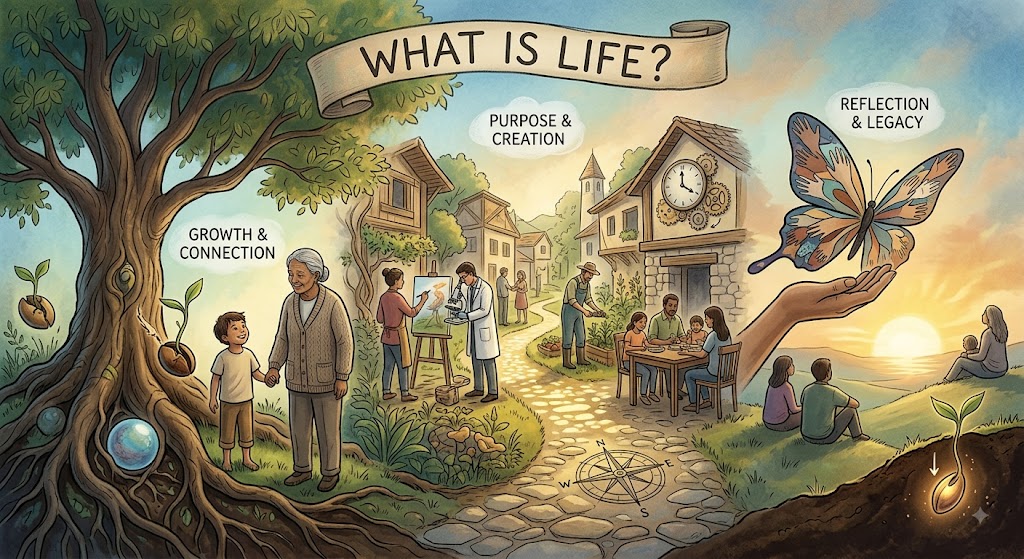
Life is the most profound mystery we are given. No textbook can fully define it, no equation can fully measure it, and no single story can fully contain it. Life is both the question and the answer, the journey and the destination. It is what we live, what we struggle with, what we celebrate, and what we eventually leave behind. To talk about life is to talk about everything — birth and death, joy and grief, purpose and chance, the individual and the world.
*1. What is Life?*
At the most basic level, life is biological. It is cells dividing, hearts beating, lungs breathing. Science tells us that life began billions of years ago with simple organisms in water, and through evolution it became the vast variety we see today: plants that turn sunlight into food, animals that migrate thousands of miles, and humans who can write poetry about the stars.
But life is more than biology. A body with a pulse is not the same as a life well-lived. Philosophers have argued for centuries about what makes life "life." Aristotle called it the pursuit of _eudaimonia_ — flourishing. The Buddha called it a cycle of suffering and liberation. Many religions call it a gift, a test, and a responsibility.
In everyday terms, life is experience. It is the first time you ride a bike without training wheels. It is losing someone you love. It is waking up at 5am for an exam, or staying up till 2am talking with a friend about nothing. It is ordinary moments that, when strung together, become a story that belongs only to you.
*2. The Phases of Life*
Life moves in phases, though they rarely have clean borders.
*Childhood* is the phase of wonder. Children ask "why" a hundred times a day because everything is new. They live in the present. A puddle is an ocean. A cardboard box is a spaceship. This is also the phase where we learn the basic rules: how to speak, how to share, how to be safe, how to love.
*Adolescence* is turbulence. The body changes, emotions intensify, and the world suddenly gets bigger. School, friendships, identity, pressure — it all collides. This is when most of us first ask big questions: Who am I? What am I good at? Do I belong? Mistakes made here often feel like the end of the world, but they are usually the beginning of self-awareness.
*Adulthood* is responsibility. Work, money, relationships, health, family. Time speeds up. The freedom you wanted as a teenager comes with bills and deadlines. This is also where purpose starts to matter. A job is not just a paycheck. A relationship is not just company. We begin to build things that will outlast us — careers, homes, children, communities.
*Old age* is reflection. The pace slows. There is more memory than future. People often become more honest, more patient, more willing to let go of small things. It is a phase of storytelling, of passing on what was learned.
None of these phases are better than the others. Each has its own beauty and its own pain. The mistake is to wish you were in a different phase instead of living the one you are in.
*3. The Struggles That Shape Us*
No life is free of struggle. That is not pessimism, it is realism.
We struggle with *failure*. Exams we don’t clear, businesses that shut down, relationships that end. Failure teaches us what success never can: humility, resilience, and the difference between what we can control and what we can’t.
We struggle with *loss*. People die. Friendships drift. Opportunities pass. Grief is the price of love. The people who hurt the most when they leave are the ones who mattered the most while they were here.
We struggle with *uncertainty*. The future is never guaranteed. We plan, but life interrupts. A pandemic, an accident, a sudden job loss — it reminds us that control is mostly an illusion. The skill is not to predict everything, but to adapt.
We struggle with *meaning*. "Why am I doing this?" is a question that comes to everyone. Doing well in school, getting a job, buying a house — and then what? Without a sense of purpose, achievement feels empty.
But struggle is not the enemy. It is the forge. Gold is not made without fire. People are not made without difficulty. The person you become after a hard year is rarely the same as the person you were before it.
*4. Joy, Love, and Connection*
If struggle gives life depth, joy gives it color.
*Joy* is small and frequent: hot chai on a rainy day, a song that gives you goosebumps, finishing a book, a joke that makes you cry with laughter. We often chase big happiness — promotions, weddings, vacations — and miss the small joys that happen daily.
*Love* is the center. Love for parents, for partners, for friends, for children, for pets, for a craft. Love is what makes us vulnerable and what makes us brave. It is the reason people risk, sacrifice, and stay. Psychologists now know that strong relationships are the single biggest predictor of a long, healthy, happy life — more than money, more than fame.
*Connection* is what turns individual lives into a society. We need to be seen and understood. We need to belong. That is why humans tell stories, make art, build rituals, celebrate festivals. In Delhi you see this during Diwali when entire streets light up, or during Eid when food is shared with neighbors. Life is not meant to be lived alone.
*5. Purpose: What Are We Here For?*
This is the question everyone eventually asks.
Some people find purpose in *service* — doctors, teachers, social workers. They measure life by how many people they helped.
Some find it in *creation* — artists, writers, engineers, chefs. They measure life by what they made.
Some find it in *family* — raising children, caring for elders. They measure life by the home they built.
Some find it in *knowledge* — scientists, scholars, students. They measure life by what they understood.
Some find it in *faith* — living according to God, dharma, or spiritual principles.
The truth is, purpose is not found once and for all. It evolves. At 15, your purpose might be to get into a good college. At 30, it might be to raise a child well. At 60, it might be to mentor someone. A meaningful life is not about having one grand purpose, but about having a direction and walking it.
Viktor Frankl, a psychiatrist who survived concentration camps, wrote that even in the worst suffering, people can find meaning. "Life never ceases to have meaning, even in suffering." That idea has helped millions. Purpose doesn’t remove pain, but it gives pain a context.
*6. Life in the Modern World*
We are living in a time unlike any before.
*Technology* has connected us. A student in Delhi can learn from a professor in Boston. A grandmother can video-call her grandchildren. But technology has also made us distracted, compared, and anxious. Social media shows us everyone’s highlight reel and makes us feel behind.
*Work* has changed. The 9-to-5 job is not the only path anymore. Freelancing, startups, content creation — people are trying new ways to earn and live. But with flexibility comes instability.
*Health* is both better and worse. We live longer, but we are more sedentary, more stressed, more sleep-deprived.
*Climate and society* remind us that our individual lives are tied to collective choices. What we eat, what we buy, how we vote — it all ripples out.
Living well today means learning new skills: digital literacy, emotional regulation, financial planning, and the ability to unplug.
*7. Lessons Life Keeps Teaching*
If life had a syllabus, it would repeat these lessons:
1. *Time is the only thing you can’t get back.* Spend it on people and things that matter.
2. *Comparison kills joy.* Someone will always have more and someone will always have less. Run your own race.
3. *You don’t have to have it all figured out.* Most adults are improvising too.
4. *Kindness is free and powerful.* A good word can change someone’s entire day.
5. *Health is wealth.* Without sleep, food, and movement, nothing else works.
6. *Growth is uncomfortable.* If you’re not a little scared, you’re probably not growing.
7. *Nothing lasts forever.* Good times and bad times both pass. That is both sad and comforting.
*8. Death and the Meaning of Life*
We don’t like to talk about death, but it is part of life. Knowing that life is finite is what makes it precious. If we had unlimited time, we would keep postponing. Because we don’t, we have to choose.
Many cultures treat death as a transition, not an end. Others see it as final, which makes the time we have even more urgent. Either way, the awareness of mortality asks us: If this was your last year, what would you do differently? If this was your last conversation, what would you say?
That question is not meant to scare us. It is meant to wake us up.
*9. How to Live Well*
There is no perfect formula, but there are practices that help most people:
- *Be present.* You can’t live in the past or future. The present is where life actually happens.
- *Learn continuously.* Read, ask questions, stay curious. A closed mind is a small life.
- *Take care of your body.* Walk, eat real food, sleep. Your mind lives in a body.
- *Invest in people.* Call your parents. Text a friend. Be there.
- *Do hard things.* Discipline today creates freedom tomorrow.
- *Give back.* Volunteer, teach, donate. Life feels bigger when it’s not just about you.
- *Make space for silence.* Prayer, meditation, journaling — anything that lets you hear yourself.
*10. Conclusion: Life is What You Make of It*
In the end, life is not something that happens to you. It is something you participate in.
You will not get every job, keep every friend, or avoid every heartbreak. But you do get to choose how you respond. You get to choose what you pay attention to, who you become, and what you leave behind.
But maybe the point of writing about it is to remind ourselves: pay attention. The ordinary Tuesday, the boring commute, the argument, the apology, the cup of tea — it’s all life.
Don’t wait for a big moment to start living. This moment is it.
As the poet Mary Oliver asked: "Tell me, what is it you plan to do with your one wild and precious life....